"8Bit transformed our observability infrastructure. Their ELK implementation reduced our incident response time by 70% and gave us visibility we never had before."
SM
Sarah Mitchell
VP Engineering
Fintech Solutions Ltd
★★★★★
"
"The DevOps transformation delivered by 8Bit enabled us to scale from 10 to 100+ deployments per day with zero downtime. Game-changing expertise."
JC
James Chen
CTO
Enterprise Cloud Inc
★★★★★
"
"Their Splunk architecture handles 5TB of daily logs flawlessly. The team's depth of knowledge in enterprise observability is unmatched."
RT
Rachel Thompson
Director of Operations
Global Retail Systems
Trusted Partners & Clients
Core Capabilities
Deep Technical Expertise
Battle-tested experience across enterprise observability, infrastructure, and application development.
ELK
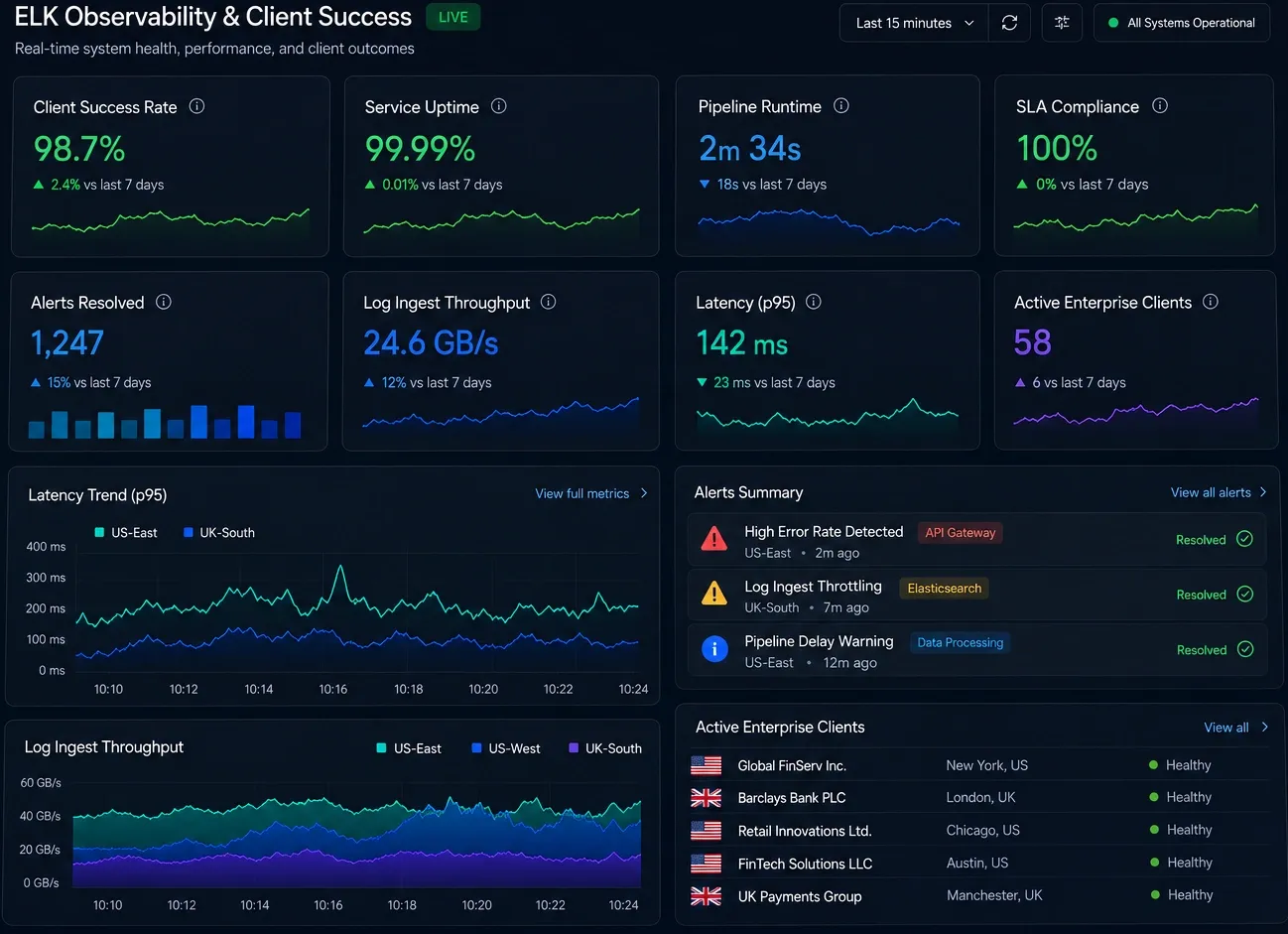
ELK Stack Mastery
Deep expertise in Elasticsearch cluster architecture, Logstash pipeline optimisation, and Kibana custom dashboards for enterprise-scale log analytics.
Multi-node cluster design & scaling
Custom ingest pipelines & processors
Advanced search & aggregation queries
Security & access control (RBAC)
Performance tuning & optimisation
Disaster recovery & backup strategies
BeatsLogstashElasticsearchKibanaFleetAPM
ELK Pipeline Architecture
Beats / Agents
→
Logstash
↓
Elasticsearch Cluster
↓
Kibana
Alerts
APM
SPL
Splunk Engineering
Enterprise Splunk deployments from architecture design to advanced analytics, SIEM integration, and compliance reporting.
Splunk Enterprise & Cloud architecture
Data onboarding & source integration
SPL query optimisation
SIEM & security use cases
Custom apps & dashboards
Capacity planning & licensing
Splunk ESITSIPhantomCIMHEC
Splunk Data Flow
Forwarder
Indexer
Search Head
↓
Splunk Enterprise
↓
SIEM
—
Analytics
OPS
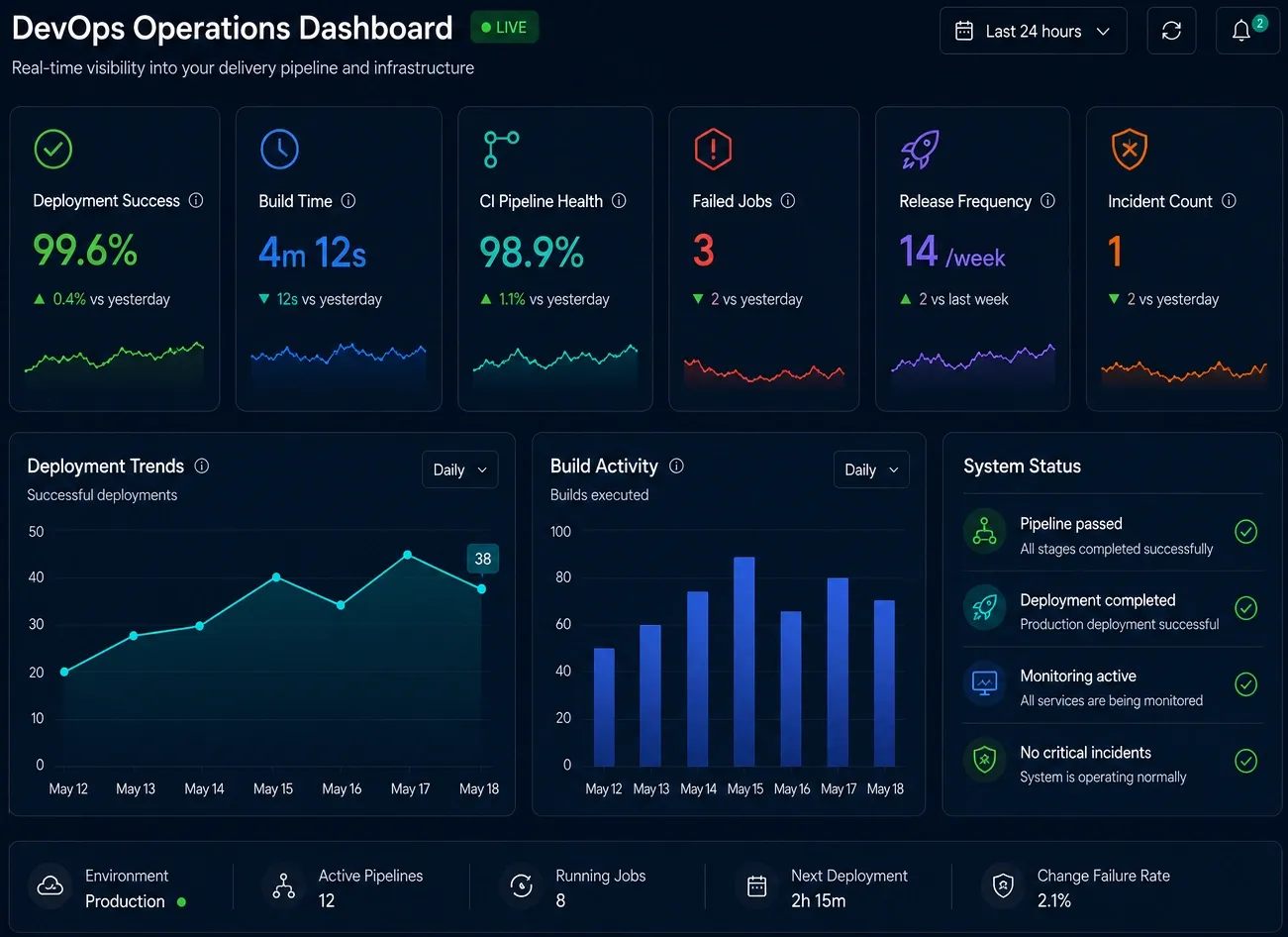
DevOps Excellence
Full-spectrum DevOps transformation including CI/CD automation, infrastructure as code, container orchestration, and cloud-native architecture.
Kubernetes cluster management
Docker containerisation strategies
Terraform & IaC best practices
GitOps workflows (ArgoCD / Flux)
Monitoring & observability stacks
Security & compliance automation
KubernetesDockerTerraformArgoCDHelm
GitOps Pipeline
Git
Build
Test
Deploy
↓
K8s
Docker
Terraform
JVM
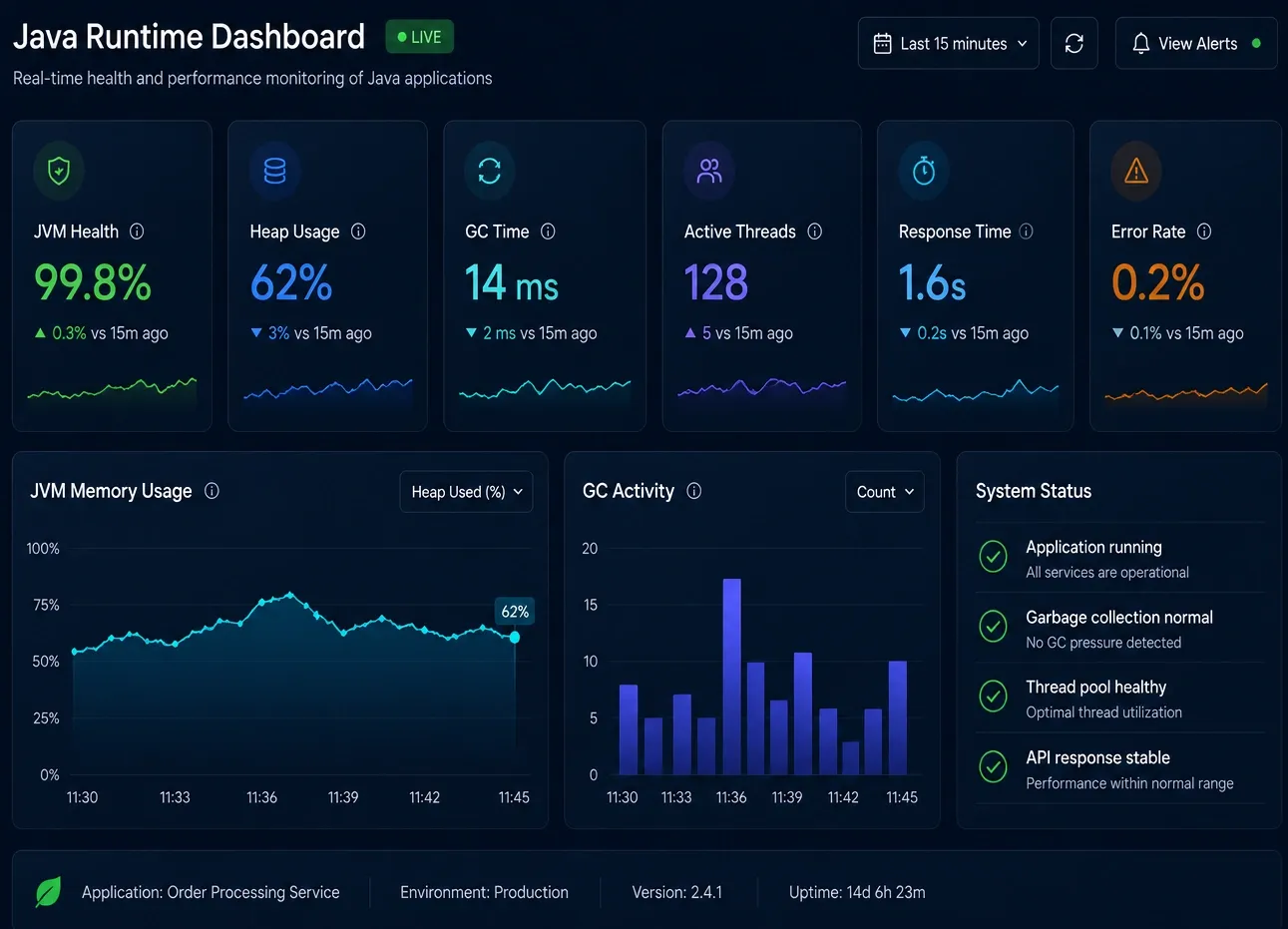
Java Enterprise
Scalable Java application development with Spring Boot, microservices architecture, and cloud-native deployment patterns.
Spring Boot & Spring Cloud
Microservices architecture
RESTful API design & GraphQL
Event-driven systems (Kafka)
Performance optimisation
Legacy modernisation
Spring BootSpring CloudJPAgRPCKafka
Spring Boot Architecture
Spring Boot
↓
REST API
Services
Data
↓
Cloud Infrastructure
Our Process
End-to-End Delivery Model
A proven methodology that takes you from strategy to sustained operational excellence.
🎯
Phase 1
Strategy & Assessment
We analyse your current infrastructure, identify gaps, and design a roadmap aligned with your business objectives.
Key Deliverables
Technical assessment
Architecture blueprint
Migration strategy
ROI analysis
1
2
⚙️
Phase 2
Implementation
Hands-on deployment of solutions with minimal disruption, following enterprise best practices and security standards.
Key Deliverables
Infrastructure setup
Application development
Integration & testing
Performance optimisation
📡
Phase 3
Support & Monitoring
24/7 proactive monitoring, incident response, and continuous optimisation to ensure peak performance.
Key Deliverables
24/7 monitoring
Incident management
Performance tuning
Security patching
3
4
📈
Phase 4
Optimisation
Continuous improvement through data-driven insights, cost optimisation, and scalability enhancements.
Key Deliverables
Cost analysis
Capacity planning
Efficiency improvements
Scalability upgrades
🎓
Phase 5
Knowledge Transfer
Comprehensive training and documentation to empower your team with expertise and operational independence.
Key Deliverables
Team training
Documentation
Best practices
Runbooks & playbooks
5
Join Our Team
Built by Engineers, For Engineers
We're a team of specialised engineers passionate about solving complex infrastructure challenges. If you thrive on cutting-edge technology and meaningful work, we'd love to hear from you.
⌨️
Technical Excellence
Work with cutting-edge technologies and world-class teams
🚀
Career Growth
Continuous learning and advancement opportunities
🏆
Impactful Work
Build systems that power enterprise infrastructure
ELK / Elasticsearch Engineer
IN-OFFICE · CONTRACT OR PERM
OPEN
Splunk SIEM Consultant
IN-OFFICE · SENIOR LEVEL
OPEN
DevOps / Platform Engineer
IN-OFFICE · MID-SENIOR
OPEN
Java Backend Engineer (Spring)
IN-OFFICE · SENIOR LEVEL
SOON
MERN Stack Developer
IN-OFFICE · MID LEVEL
SOON
Frequently Asked Questions
Answers to the questions enterprise teams ask most often about ELK, Java, DevOps, MERN, consulting, and our wider platform and AI services at 8Bit System.
ELK Stack
Part of our broader ELK & Observability Core Solutions practice, covering the full Elastic Stack alongside our dedicated Observability domain work.
Observability platforms unify logs, metrics, and traces so engineering teams can move from an alert to root cause without switching between disconnected tools. Our Observability practice builds this on the Elastic Stack through Elastic Observability Services, correlating infrastructure health with application performance in a single view. Teams typically see faster incident resolution once logs, metrics, and traces live in one place instead of three separate dashboards.
Logstash Consulting covers pipeline architecture, Grok pattern development, and performance tuning — the ingestion layer that parses and enriches raw data before it reaches Elasticsearch. Poorly designed pipelines are a common source of dropped events and delayed dashboards, so tuning worker counts, batch sizes, and persistent queues is often where the biggest reliability gains come from. This work pairs naturally with our broader Elastic engagements once ingestion is stable.
Effective Kibana dashboards are built around what each audience actually needs to act on — engineering teams need drill-down detail, executives need a summary view — rather than one generic dashboard for everyone. Our Kibana Consulting service designs role-based dashboards with proper access control through Kibana Spaces, and optimizes query performance so dashboards stay fast as data volume grows within a broader Elastic Observability deployment.
Vector search converts text into numerical embeddings and finds results by semantic similarity rather than exact keyword matches, so it returns relevant results even when the query wording differs from the source content. Our Elastic AI & Vector Search service implements this alongside retrieval-augmented generation patterns, often layered on top of an existing Elastic deployment rather than requiring a separate search stack.
A SIEM centralizes security events and applies detection rules — often mapped to frameworks like MITRE ATT&CK — so threats surface automatically instead of relying on manual log review across dozens of disconnected systems. Our Elastic SIEM Services tune these rules to each client's specific threat model and support compliance reporting as part of our broader Security practice, so detection and audit evidence come from the same platform.
Yes, with careful planning. Elastic Migrations uses rolling upgrade strategies and checksum-based data validation to move clusters through major versions, or consolidate multiple clusters, without service interruption. This approach is documented in detail in our Elasticsearch upgrade case study, based on a real production migration. If you're evaluating a similar upgrade, our team can assess your current cluster and recommend the right path — reach out to discuss your setup.
Java
Part of our broader Java Development Core Solutions practice, spanning framework work, architecture, and legacy modernization.
We build REST APIs, event-driven microservices, and full enterprise platforms using Spring Boot 3.x with layered, test-driven architecture rather than ad-hoc code structure. Our Spring Boot Development service includes Spring Security implementation, Spring Data JPA for the data layer, and Spring Kafka for asynchronous processing — with authentication and authorization built in from day one instead of added as an afterthought before launch.
Not every monolith needs decomposition — it's usually worth pursuing once scaling, deployment speed, or team ownership boundaries become a real bottleneck rather than a theoretical concern. Our Java Microservices service uses domain-driven design to identify natural service boundaries, so the split follows how the business actually operates rather than an arbitrary technical line drawn through the codebase. We typically start with the highest-friction module first, so the team sees a working result before committing to a full decomposition.
It's manageable, but not something to do blind. Before touching legacy code, our Java Application Modernization service first adds characterization and regression tests to establish a safety net, then refactors incrementally using patterns like Strangler Fig so the existing system keeps running throughout the migration. This avoids the common failure mode of a risky, all-at-once rewrite with no fallback if something breaks.
The most common culprits are unoptimized garbage collection settings, memory leaks from object retention, N+1 database queries, and thread contention under concurrent load — often invisible until traffic scales past what was tested. Our Java Performance Optimization service profiles JVM heap and thread behavior with production-representative load to pinpoint the actual bottleneck, rather than guessing at a fix and hoping it holds.
Yes. Enterprise Java Consulting starts with a focused 2–4 week architecture review — identifying technical debt and security risk before any implementation work begins or budget is committed. This gives teams a prioritized, evidence-based roadmap they can act on internally with their own engineers, or hand back to us for delivery. If a review sounds like the right first step, get in touch to scope one.
DevOps
Part of our broader DevOps & Cloud Automation Core Solutions practice, covering pipelines, infrastructure, and container platforms end to end.
Deployment failures are usually a symptom of manual handoffs, inconsistent environments, or missing automated testing gates rather than a single root cause. Our DevOps Consulting engagements start with an infrastructure and workflow assessment, then rebuild the pipeline using automated build, test, and deployment stages. Clients typically move from multi-day, high-risk releases to deployments measured in minutes, with rollback-ready safety nets built in so a failed release never reaches production unnoticed.
A mature pipeline automates build compilation, automated testing (unit, integration, security), artifact versioning, and staged promotion across environments. Our CI/CD Automation service configures this using tools like Jenkins, GitHub Actions, or GitLab CI, paired with Terraform & Infrastructure as Code so environment provisioning is as automated as the code deployment itself, rather than one being automated while the other stays manual.
Kubernetes automates scaling, self-healing, and workload scheduling across a cluster, so applications handle traffic spikes without manual intervention or emergency provisioning. Our Kubernetes Consulting service designs cluster architecture, horizontal pod autoscaling, and GitOps-based deployment on EKS, AKS, or GKE, matched to actual traffic patterns rather than worst-case guesses baked into a fixed server count. This typically reduces both idle infrastructure cost and the risk of an under-provisioned cluster during a sudden spike.
In most cases, yes. Docker Containerization focuses on isolating dependencies through Dockerfile design rather than rewriting application code, which lets legacy systems run consistently across development, staging, and production instead of behaving differently on each. This also removes the "works on my machine" class of bugs that often stalls legacy releases before they reach a customer-facing environment, and gives the team a clean foundation to build on going forward.
Infrastructure as Code defines cloud resources in version-controlled, declarative configuration rather than manual console changes, making infrastructure changes repeatable, auditable, and peer-reviewable in the same way application code already is. Our Terraform & IaC service builds reusable modules across AWS, Azure, and GCP, tested before they reach production, often paired with our wider DevOps Consulting practice for ongoing governance and drift detection.
Alerting thresholds should be reviewed after any significant architecture change, and audited quarterly at minimum — static thresholds tend to become noisy or blind to new failure modes over time. Our Monitoring & Alerting service audits existing monitors, tunes thresholds against real baseline data, and builds composite alerts that reduce false positives without missing real incidents. If your alerts are creating more noise than signal, schedule a monitoring audit with our team.
Consulting
Every engagement begins with a technical assessment of the existing environment, followed by an architecture blueprint and a phased implementation plan — the same methodology applied across DevOps Consulting and Enterprise Java Consulting projects. This structured approach reduces implementation risk and keeps delivery aligned to measurable outcomes, with milestones agreed upfront so both teams can track progress against concrete deliverables instead of vague timelines.
We work with organizations of varying scale, from mid-sized engineering teams standing up a first CI/CD pipeline to large enterprises consolidating multiple Elasticsearch clusters through Elastic Migrations. Engagement scope adjusts to the environment's maturity — some clients need a focused audit, others need embedded, ongoing support through Enterprise Java Consulting-style retainers, depending on where the team is today. The starting engagement is usually smaller than people expect, and scales up only once the value is proven.
A project-based engagement delivers a defined outcome — a migration, an implementation, an upgrade — with a clear start, end, and scope of work. Managed services, by contrast, provide continuous monitoring, optimization, and support after go-live, since most platforms need ongoing tuning as data volume and usage patterns change. Many clients start with Elastic Migrations or Kubernetes Consulting as a project, then transition into ongoing support once the platform is live.
The best starting point is a structured conversation about your current environment, pain points, and goals — from there we scope whether an architecture review, audit, or phased implementation makes the most sense for where your team is today. There's no fixed package applied regardless of context; the recommendation follows the assessment, not the other way around. Contact our team to schedule a consultation, or explore our About page to learn more about how we work.
MERN
Part of our broader MERN Solutions Core Solutions practice for full-stack JavaScript application delivery.
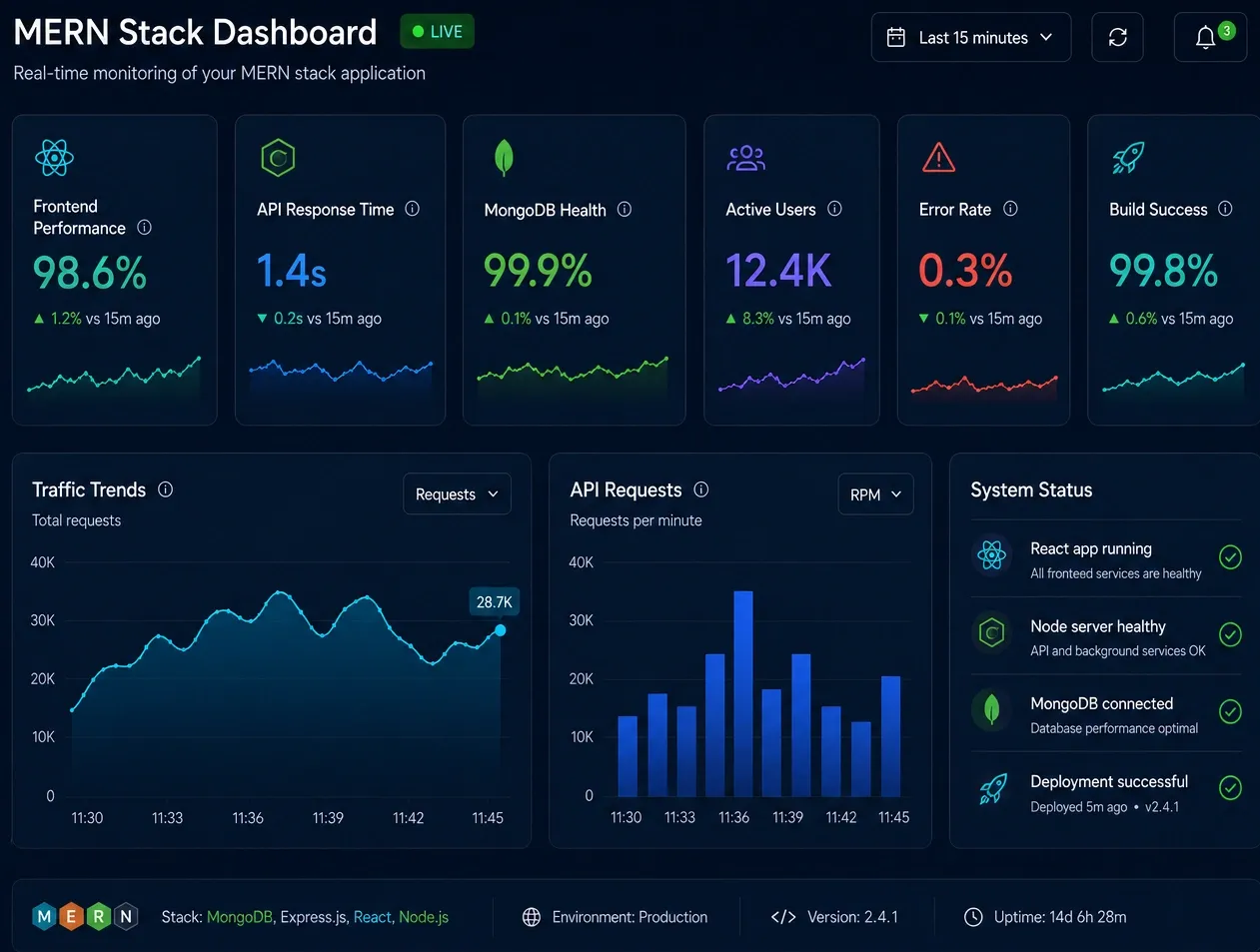
Yes. Our MERN Solutions team builds full-stack applications using MongoDB, Express, React, and Node.js — a single JavaScript codebase across frontend and backend, which simplifies handoffs between teams and speeds up iteration since developers aren't context-switching between languages. This is typically paired with the same infrastructure practices used across our DevOps Consulting engagements once an application is ready to scale.
A single JavaScript stack across the frontend and backend means one team, one language, and fewer integration issues between layers built by different specialists on different schedules. React's component model also speeds up UI iteration once the core data model is stable. Our MERN Solutions service is often the right fit for products that need to move fast without sacrificing structure, and pairs well with Web Application engagements for larger, multi-module builds.
Yes — most of our MERN work is exactly that: software built around a specific business workflow rather than a generic starter template stretched to fit. Our MERN Solutions team and Custom App Development practice work together on these builds, since a workflow-specific application often needs custom logic on both the frontend and the API layer, not just a themed template with different colors.
Services
A closer look at the two practices most engagements start with — training, case studies, and getting-started paths for ELK and Java — plus how DevOps fits alongside broader cloud operations.
Yes. Alongside implementation work, our ELK Stack Training program covers Elasticsearch, Logstash, and Kibana fundamentals through to production operations, aimed at teams who want to run day-to-day changes themselves rather than depending on outside consultants for every update. It's often paired with an initial Elastic deployment so the team learns on the same architecture they'll be maintaining.
Yes — this is documented in detail in our cross-cluster ELK case study, which covers a real production consolidation of multiple Elasticsearch clusters into a unified, cross-cluster replicated architecture. The same approach informs how our Elastic Migrations service plans consolidation projects, validating data integrity at every stage rather than assuming a clean cutover.
The fastest path is usually a scoped pilot rather than a full enterprise rollout on day one — deploy Elasticsearch, Logstash, and Kibana against one real data source, prove the value, then expand. Our ELK & Observability practice scopes this first phase deliberately small, and it typically feeds directly into a fuller Elastic Observability Services engagement once the pilot demonstrates results.
Yes. Our Java Training program is often bundled with delivery work so a client's own engineers pick up the patterns being used in their codebase, rather than treating the consultants' output as a black box. This sits within our broader Java Development practice and is commonly requested toward the end of a Java Application Modernization engagement, once the team is ready to own the new architecture.
Yes — this is one of the more common entry points. Enterprise Java Consulting offers standalone code and architecture reviews, often surfacing the same class of issues addressed in Java Performance Optimization engagements, without requiring a commitment to full implementation work upfront. Many clients use this as a low-risk way to validate whether a deeper engagement is actually needed.
DevOps automation handles build, test, and deployment pipelines, while DevOps as a broader operational domain also covers the ongoing infrastructure, monitoring, and incident-response practices that keep systems running day to day — the two are related but not identical in scope. Our DevOps Consulting service typically starts with pipelines and expands into this wider operational picture as a client's platform matures. If you're unsure which scope fits your current stage, talk to our team about where to start.
Ready to Transform Your Infrastructure
Let's Build Something Exceptional Together
Schedule a consultation with our solutions architects to discuss your infrastructure challenges and explore how we can help.
✓
Free infrastructure assessment
✓
Architecture recommendations
✓
Transparent pricing & roadmap
Get in Touch
📅
Book a Meeting
Schedule a 30-minute consultation with our team
✉️
Email Us
contact@8bitsystem.com
💬
Live Chat
Chat with our solutions team now
NEED A STRONG TECH PARTNER?
Reliable ELK, Java, DevOps, MERN, AI/ML, and custom solutions for modern enterprises.
Clear planning. Practical delivery. Real engineering support.
Built for modern enterprises, startups, and technical teams.